


In short: Chișinău to Iași is roughly 130–170 km with one border crossing; Iași to Suceava is about another 150 km. In 5–7 days you can explore the former capital of the Principality of Moldavia and Bukovina's UNESCO-listed painted monasteries. A car is the easiest option; check timetables and prices before you go.
Driving from Chișinău to Iași and on into Bukovina is one of the most natural ways to extend a trip to Moldova. It is a journey through the lands of the historic Principality of Moldavia: from the capital of today’s Republic of Moldova, through Iași, the principality’s former capital, to the monasteries built by Stephen the Great, Petru Rareș and the Movilă family. Bukovina’s painted churches, covered in frescoes on the outside as well as the inside, are on UNESCO’s World Heritage List and look like nothing else in Europe.
The good news is that distances are modest. Chișinău to Iași takes a few hours including the border, and Iași to Suceava is another two to three hours. The difficulty lies elsewhere: the monasteries are scattered across the valleys of southern Bukovina, public transport to them is sparse, and border waiting times between Moldova and Romania are hard to predict. This guide brings together everything you need to plan calmly: border options, transport, a day-by-day plan, where to stay, what to eat, a budget and the mistakes that are easy to avoid.
A word of caution up front: timetables, prices and rules change. All figures and times in this article are approximate at the time of writing and should be checked for your travel dates. We point you to where the up-to-date information lives.
The route at a glance
| Item | What to know |
|---|---|
| Total distance | about 650–800 km as a loop, depending on the variant |
| Duration | 4–5 days (minimum) to 7 days (comfortable) |
| Countries | Republic of Moldova and Romania (EU, Schengen area) |
| Borders | one or two crossings (Sculeni, Leușeni–Albița, Lipcani–Rădăuți-Prut) |
| Currencies | Moldovan leu (MDL) and Romanian leu (RON) |
| Key stops | Chișinău, Iași, Suceava, Gura Humorului, Voroneț, Humor, Moldovița, Sucevița and Putna monasteries |
| UNESCO sites | “Churches of Moldavia”: eight painted churches in Bukovina |
| Best season | May to October |
| Transport | a car is easiest; buses, trains and local taxis also work |
| Languages | Romanian; Russian is widely understood in Moldova but not in Romania; English is common among younger people |
That last row matters. English works well in hotels, cafés and with younger people in Iași and Suceava, but in Bukovina’s villages you will often meet hosts who speak only Romanian. A translation app and a few Romanian phrases go a long way.
Route overview
The classic version runs: Chișinău — border — Iași — Suceava — Gura Humorului (the base for the monasteries) — Putna — and back either via Iași or via the northern crossing at Lipcani and on through Bălți to Chișinău. You can drive the loop in either direction; below we describe it clockwise, starting with Iași.
| Leg | Distance (approx.) | Driving time (approx.) | Notes |
|---|---|---|---|
| Chișinău — Iași via Sculeni | 150–170 km | 3–4 hours incl. border | via Ungheni or Pîrlița |
| Chișinău — Iași via Leușeni–Albița | about 200 km | 3.5–4.5 hours incl. border | main corridor, good road in Moldova |
| Iași — Suceava | about 145 km | 2–2.5 hours | car, train or bus |
| Suceava — Gura Humorului | about 35–40 km | 40–50 minutes | base for Voroneț and Humor |
| Gura Humorului — Voroneț | about 5 km | 10 minutes | walkable or easy by bike |
| Gura Humorului — Moldovița — Sucevița | about 60–70 km | 1.5–2 hours | over the Ciumârna pass |
| Sucevița — Putna | about 30–40 km | 40–60 minutes | |
| Putna — Rădăuți-Prut (border) | about 150 km | 2.5–3 hours | via Rădăuți and Botoșani |
| Lipcani — Chișinău | about 250 km | 3.5–4 hours | via Edineț and Bălți |
All distances are rounded. Romania is steadily upgrading its roads and new motorway sections in the region open as they are completed, so check your navigation app before setting off.
When to go
Bukovina sits in the foothills of the Eastern Carpathians, so it is cooler and the weather more changeable than in Chișinău.
May and June. Fresh greenery, meadows in flower and long days. There are fewer visitors than in July, and the guesthouses are open. Expect some rain, especially in the hills.
July and August. High season: warm weather, all roads open, summer festivals and craft fairs. At weekends the best-known monasteries draw pilgrim coaches and tour groups. Book accommodation ahead.
September and October. Arguably the best time. The forests turn yellow and red, roads are quieter and the weather is usually dry. Bear in mind that around 14 October Iași celebrates the feast of St Parascheva, one of the largest Orthodox pilgrimages in the region. During those days there are huge queues at the cathedral, closed streets and almost no free rooms.
November to March. The monasteries are open all year round — they are living communities. Bukovina is beautiful under snow, but mountain passes such as Rarău and Ciumârna can be tricky and many guesthouses run reduced hours. In winter, stick to main roads and check the forecast.
Easter and Christmas deserve a special mention: these are major holidays when the monasteries are at their most beautiful but also at their busiest. Orthodox Easter falls on the same date in Romania and Moldova, while Romania celebrates Christmas on 25 December.
Documents and the border
The route crosses the external border of the European Union. That means full passport and customs checks every time you cross between Moldova and Romania.
What to check in advance
- Passport and visas. Entry to Romania follows Schengen rules. Citizens of many countries can enter visa-free for up to 90 days in any 180-day period; Moldovan citizens with biometric passports do not need a visa. If your nationality requires a visa, apply in advance at a Romanian consulate. With the EU’s Entry/Exit System (EES) and, later, ETIAS, border procedures may change, so check the official EU websites.
- Car documents. Registration certificate, driving licence, a Green Card covering both Romania and Moldova and, where relevant, a power of attorney from the owner.
- Vignettes. Foreign-registered cars need a vignette in Moldova; in Romania you need an electronic vignette (rovinieta) for national roads. Both can be bought online or near the border.
- Customs limits. Entering the EU, there are limits on cigarettes and alcohol and strict rules on animal products. As a rule, you cannot bring meat or dairy products — including Moldovan brânză cheese — into the EU from Moldova for personal use.
Which crossing to choose
- Sculeni — Sculeni. The closest crossing to Iași: about 20–25 km from the border to the city centre. On the Moldovan side you reach it via Ungheni or Pîrlița.
- Leușeni — Albița. The main and usually best-equipped road crossing. It is a detour for Iași, but the stretch back to Chișinău via Hîncești is fast.
- Ungheni — Ungheni. Another option near Iași, also used by the railway. Near Ungheni stands an old 19th-century railway bridge over the Prut that is traditionally associated with Gustave Eiffel’s workshop.
- Lipcani — Rădăuți-Prut. The northern crossing, handy if you head straight for Bukovina, bypassing Iași, or return from there.
Waits range from a few minutes to several hours, especially on Friday evenings, Sundays, before public holidays and in summer. Moldova’s Border Police (border.gov.md) and Romania’s Poliția de Frontieră (politiadefrontiera.ro) publish information about crossing points and sometimes about queues. For documents, limits and queues in detail, see our separate guide to crossing the Moldova–Romania border.
Getting around: car, bus, train or tour
By your own or a rented car
This is the most convenient option. Bukovina’s monasteries are spread across several valleys, and with a car you decide where to linger and where to spend the night. Roads are generally decent but mostly two-lane, with plenty of lorries, villages and speed limits. On mountain stretches take care: hairpin bends, fog and occasionally animals on the road.
If you rent a car in Chișinău, make sure the company allows you to take it into Romania and ask for all the necessary paperwork: power of attorney, Green Card and proof of insurance. Some rental firms do not allow cross-border trips at all or charge extra. An alternative is to reach Iași by public transport and rent a car there — both international and local rental companies operate in Iași and Suceava.
By bus and minibus
Scheduled buses and minibuses run daily between Chișinău and Iași, including overnight and early-morning departures. The journey usually takes about three to four hours, but everything depends on the border queue. From Iași, buses and minibuses run to Suceava from the city’s bus stations; from Suceava, local services go to Gura Humorului, Rădăuți and Câmpulung Moldovenesc. Buses to individual monasteries are rare, so many travellers take a taxi or hire a driver for the day.
By train
Rail links Iași and Suceava (Romania’s CFR Călători), and from Suceava lines run towards Gura Humorului and Câmpulung. The train is a relaxed way to cover the longest leg of the trip. Passenger services between Chișinău and Iași have been launched and changed several times in recent years — check the current status on the websites of Calea Ferată din Moldova and CFR Călători shortly before you travel.
On a guided tour
Day tours to the Bukovina monasteries leave regularly from Iași and Suceava, and multi-day trips to Romania are sold in Chișinău. It is a good choice if you do not want to drive or juggle timetables. The downside is a fixed schedule and little time at each stop.
Day 1. Chișinău to Iași
The first day is mostly about the road. Leave early in the morning: you are less likely to hit a long border queue, and you will have the afternoon for a first walk around Iași.
On the Moldovan side
If you cross at Sculeni, the road from Chișinău heads north-west. Ungheni is worth a stop on the way: a border town on the Prut with a railway station and the old railway bridge. If you choose Leușeni, the route passes Hîncești, home to the Manuc Bey estate — a restored 19th-century palace and park, good for a 30–60 minute break.
Before the border, fill up the tank and spend your small Moldovan lei: hardly anyone in Romania will take them, and exchange rates near the border are usually poor. Bring water and snacks in case of a long queue.
The border and your first kilometres in Romania
Once across the border, you are in the European Union. If you have not bought the Romanian vignette online, buy it straight away. Moldova and Romania share the same time zone, so there is no need to change your watch. As for your phone: since 1 January 2026 Moldova has been part of the EU’s “Roam Like at Home” area, so customers of EU and Moldovan operators pay domestic rates in both countries; everyone else should check with their operator or buy a Romanian SIM card.
From Sculeni to central Iași is about half an hour. The city is spread over hills, so navigation apps may send you up steep streets and around bypasses. Parking in the centre is paid; it is easier to leave the car at your hotel and walk.
Iași: the former capital of Moldavia
Iași is one of Romania’s largest cities and the historic heart of its north-east. From the 16th century until the union with Wallachia in the 19th century it was the capital of the Principality of Moldavia, and you can still feel it in the scale of its churches, palaces and public buildings. In 1860 the first modern university in what is now Romania was founded here; the poet Mihai Eminescu and the writer Ion Creangă worked here, and the influential literary society Junimea met here. Iași is often called Romania’s cultural capital.
For travellers coming from Chișinău, Iași is fascinating for another reason: this is the same historical Moldavia — the same cuisine, similar traditions and a shared past — only on the other side of the Prut. Comparisons come naturally.
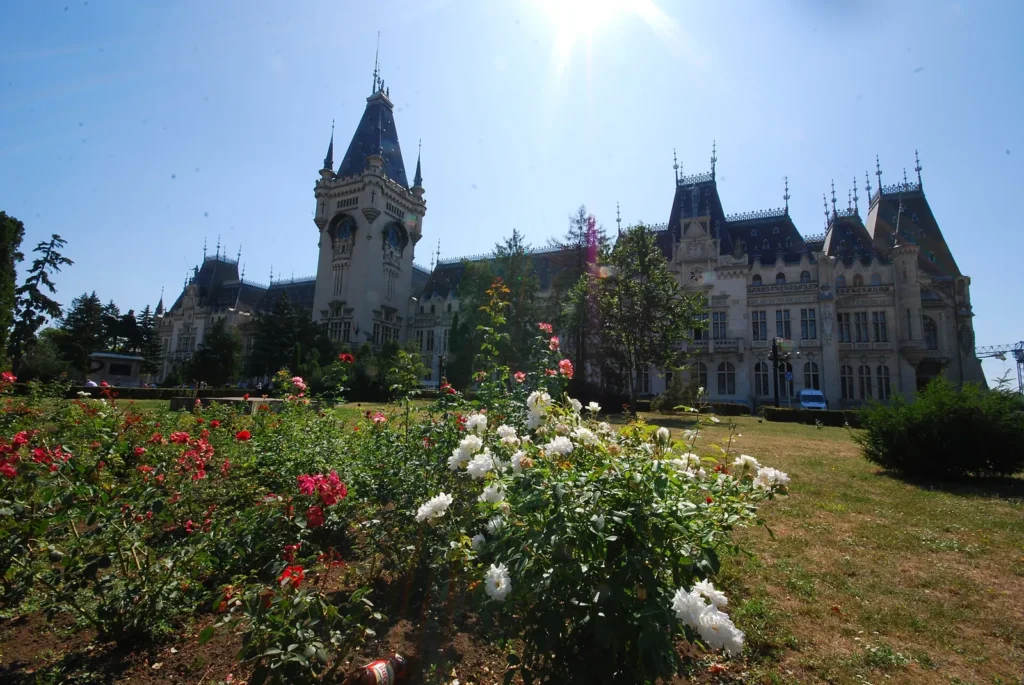
The Palace of Culture
Iași’s best-known landmark is the Palace of Culture, a huge neo-Gothic building with a clock tower, built in 1906–1925 on the site of the old princely court. It was originally an administrative and law-court building; today it houses the Moldova National Museum Complex, which brings together several museums — history, ethnography, art, and science and technology. Allow at least two to three hours. Check opening hours and ticket prices on the museum complex’s official website.
In front of the palace is a square with a statue of Stephen the Great, and from here the city’s main pedestrian axis begins.
The Church of the Three Hierarchs
The Church of the Three Hierarchs (Trei Ierarhi), built in 1637–1639 under Prince Vasile Lupu, is one of the most unusual buildings in Eastern Europe. Its outer walls are entirely covered with stone carving: geometric and floral patterns, bands and rosettes. Vasile Lupu himself is buried here, as are the scholar-prince Dimitrie Cantemir and Alexandru Ioan Cuza, the first ruler of the united Romanian state, whose remains were moved here. It is a working church, so dress and behave accordingly and check whether photography is allowed inside.
The Metropolitan Cathedral and St Parascheva
The Metropolitan Cathedral of Iași is the main church of the Metropolis of Moldavia and one of Romania’s largest Orthodox cathedrals. It holds the relics of St Parascheva, brought to Iași in 1641 under Vasile Lupu. Every year around 14 October, her feast day, hundreds of thousands of pilgrims come to the cathedral from all over Romania and Moldova. If you happen to be here then, expect queues lasting hours, closed streets and expensive rooms — or plan your trip around the event on purpose.
Ștefan cel Mare Boulevard and the centre
Between the Palace of Culture and Union Square runs Ștefan cel Mare și Sfânt Boulevard — a pedestrian avenue lined with the cathedral, churches, theatres and cafés. At its end stands the Vasile Alecsandri National Theatre, a late-19th-century building designed by the Viennese firm of Fellner & Helmer, known for theatres across Central and Eastern Europe. You can see the interior by going to a performance or, when available, on a tour.
Union Square (Piața Unirii) is the traditional meeting place and the point where the main streets converge. From here it is easy to continue to the university and Copou Park.
The university and Copou Park
The main building of Alexandru Ioan Cuza University is a monumental edifice whose grand hall, the Hall of Lost Steps (Sala Pașilor Pierduți), was painted by the artist Sabin Bălașa. If the building is open to visitors, step inside for a few minutes.
A little further on is Copou Park, one of the oldest public parks in Romania. Here stands the famous lime tree under which, according to tradition, Mihai Eminescu liked to write; nearby are a monument to the poet and a small Junimea museum. The park is lovely for an unhurried stroll, especially in summer and early autumn.
The Botanical Garden
The Anastasie Fătu Botanical Garden, founded in 1856, is considered Romania’s oldest university botanical garden. It covers a large area north of the centre, with greenhouses, a rose garden and sections representing different natural regions. With half a day and good weather, it makes a pleasant alternative to museums.
Hilltop monasteries: Golia, Cetățuia and Galata
Around the historic centre, fortified monasteries built by princes in the 16th and 17th centuries crown the hills. Golia is right in town and has a tall bell tower that can sometimes be climbed. Cetățuia and Galata stand on hills south of the centre, with views over the city; a taxi is the easiest way up.
Ion Creangă’s cottage
On a slope in the Țicău district stands the Bojdeuca, the small cottage where Ion Creangă lived. He wrote “Memories of My Boyhood” and fairy tales known to every Romanian and Moldovan reader, and this was one of the country’s first literary memorial museums. It is small and charming, best for those who know his work.
Where to eat in Iași
The food in Iași is Moldavian: mămăligă (polenta) with cheese and sour cream, ciorbă (sour soups), sarmale (cabbage rolls), plăcinte (filled pastries) and, for dessert, papanași — cheese doughnuts with sour cream and jam. The centre has plenty of traditional restaurants, cafés and patisseries. As a rough guide, lunch at an inexpensive restaurant usually costs a few dozen Romanian lei per person; dinner at a good restaurant costs more. Check menus and prices on the spot, as they change quickly.
Where to stay
For one or two nights the centre is the most convenient area: around the Palace of Culture, Ștefan cel Mare Boulevard and Union Square. Everything important is within walking distance. If you have a car, look for a place with parking — it is scarce in the centre. Prices rise sharply during the St Parascheva festival and major university events.
Day 2. Iași at a slower pace
Give the second day to the city without rushing. A sample plan:
- Morning. The Palace of Culture and its museums, before the groups arrive.
- Midday. The Church of the Three Hierarchs and the Metropolitan Cathedral, lunch in the centre.
- Afternoon. A walk along the boulevard, the National Theatre and Union Square, then the university and Copou Park.
- Evening. Dinner and, if you can get tickets, a play or concert.
If you only have one day in Iași, focus on the Palace of Culture, the Three Hierarchs, the cathedral and a walk through the centre — about five or six hours.
Day 3. Iași to Suceava
The drive from Iași to Suceava takes about two to three hours. You can go direct or make stops along the way.
On the way: Probota Monastery
Probota Monastery, built under Petru Rareș, is also part of the UNESCO “Churches of Moldavia” listing. It lies a little off the direct road, near the small town of Dolhasca. Its exterior paintings have survived less well than those at Voroneț or Sucevița, but the interior frescoes are impressive and there are usually fewer visitors. If you are driving and like quiet places, Probota makes a good first stop.
Suceava: Stephen the Great’s capital
From the late 14th to the mid-16th century Suceava was the capital of the Principality of Moldavia. Above the city rises the Seat Fortress (Cetatea de Scaun), founded in the late 14th century and enlarged under Stephen the Great. In 1476 it withstood a siege by the army of the Ottoman sultan Mehmed II. Today the partly restored walls, towers and gates are open to visitors, and from the hill you can see the city and the Suceava river valley. In summer the fortress sometimes hosts history festivals and re-enactments.
Next to the fortress is the Bukovina Village Museum, an open-air museum of wooden houses, mills and churches brought here from villages across the region. It is a good introduction to traditional Bukovinian life before you head into the villages yourself.
In town, visit the Monastery of St John the New, which holds the relics of the saint; its Church of St George is painted on the outside and is also on the UNESCO list. Another UNESCO church, at Pătrăuți, is just a few kilometres from Suceava — one of the oldest surviving churches from Stephen the Great’s time.
Dragomirna Monastery
Twelve kilometres north of Suceava stands Dragomirna Monastery, founded in the early 17th century by Metropolitan Anastasie Crimca. Its main church is striking for its proportions: very tall and narrow, with a carved stone band and an elegant tower. Dragomirna has no exterior paintings and is not on the UNESCO list, but many travellers call it one of the most beautiful monasteries in the region. It is enclosed by massive walls and has a museum of manuscripts and embroidery.
Where to spend the night
On day three it is convenient to stay either in Suceava or already in Gura Humorului, a small town that serves as the base for the monasteries. Suceava has more restaurants and hotels; Gura Humorului is closer to Voroneț and Humor.
A little history: why Moldova, Iași and Bukovina share one story
To keep this route from becoming just a series of pretty pictures, it helps to know the basic outline.
The Principality of Moldavia
The Principality of Moldavia emerged in the mid-14th century in the Carpathian foothills, in what is now Bukovina. Its first capitals were Baia, then Siret and Suceava. At its height the principality stretched from the Carpathians to the Dniester and the Black Sea, covering today’s Republic of Moldova, north-eastern Romania and part of present-day Ukraine.
Its best-known ruler was Stephen III the Great, who reigned from 1457 to 1504. He spent decades fighting the Ottoman Empire, Hungary and Poland and, by tradition, built churches and monasteries after his victories. Putna, Voroneț, Pătrăuți and many other churches date from his era. His son Petru Rareș continued the tradition, and exterior fresco painting flourished under him.
In 1564 the capital moved from Suceava to Iași, which remained the principality’s main city until the union with Wallachia in 1859 — hence the wealth of churches, palaces and schools in Iași.
Divided lands
In 1775 the north-western part of the principality — Bukovina proper — passed to the Habsburg Monarchy and remained Austrian until 1918. Austrian influence is still visible in the architecture of Suceava, Rădăuți and Chernivtsi. In 1812 the eastern half of the principality, between the Prut and the Dniester, was annexed by the Russian Empire and became known as Bessarabia — the core of today’s Republic of Moldova.
Borders shifted several times in the 20th century. Today southern Bukovina, with Suceava, is part of Romania, while northern Bukovina, with Chernivtsi, belongs to Ukraine. On this route you travel through different fragments of one historical space.
Why it matters to travellers
This history explains a lot: why Moldova and Romania share a literary language, why Suceava has Austrian-era façades, why Stephen the Great is revered on both banks of the Prut and why the food and customs are so alike. Locals are happy to talk about history, but it can be a sensitive subject — listen respectfully and do not rush to judgement.
Bukovina’s painted monasteries: what to know first
Before you set off, it helps to understand what you are about to see. In the 15th and 16th centuries, under Stephen the Great and especially under his son Petru Rareș, Moldavia developed a tradition of covering not only the interiors but also the exterior walls of churches with frescoes. The painted façades were a kind of “Bible for the people”: they showed the Last Judgement, the lives of the saints, the genealogy of Christ, the Akathist Hymn to the Virgin, the Ladder of Divine Ascent and even historical events. The colours have survived five centuries of rain and frost remarkably well, although the north walls, exposed to the wind, have suffered more in many churches.
In 1993 UNESCO inscribed the “Churches of Moldavia” on its World Heritage List. Today the listing includes eight churches: Arbore, Humor, Moldovița, Pătrăuți, Probota, St George’s in Suceava, Voroneț and Sucevița (the last added in 2010). Most of them are working monasteries with communities of nuns or monks.
A few rules apply everywhere:
- Dress. Cover shoulders and knees. Women are often offered a skirt or headscarf at the entrance, but it is better to bring your own.
- Behaviour. Speak quietly, keep out of closed areas and living quarters, and do not disturb services.
- Photos and video. Photography outside is usually allowed, sometimes for a fee. Inside the churches it is often forbidden — watch for signs.
- Fees. There is normally a small entrance fee and a separate fee for photography. Carry Romanian lei in cash: cards are not accepted everywhere.
- Hours. Monasteries are open from morning to evening, but exact hours vary by season. The softest light for photographing the façades is early morning and late afternoon.
How to read the frescoes
The painted façades look chaotic until you know where to look. Most churches follow a similar scheme:
- The west wall is usually devoted to the Last Judgement: Christ and the heavenly hosts at the top, the judgement below, paradise on the viewer’s left and hell on the right.
- The south wall, the sunniest, usually carries the Tree of Jesse (Christ’s genealogy) and the Akathist Hymn, sometimes with the Siege of Constantinople.
- The north wall suffers most from the weather; it may show the Ladder of Divine Ascent (at Sucevița) or scenes from the Creation.
- The apses are decorated with rows of saints, prophets and martyrs — the so-called “Prayer of All Saints”.
If you want the details, hire a local guide or use an audio guide where one is offered. Many nuns are happy to talk about their church, but do not interrupt them during services or work.
Day 4. Voroneț, Humor and Arbore
Voroneț
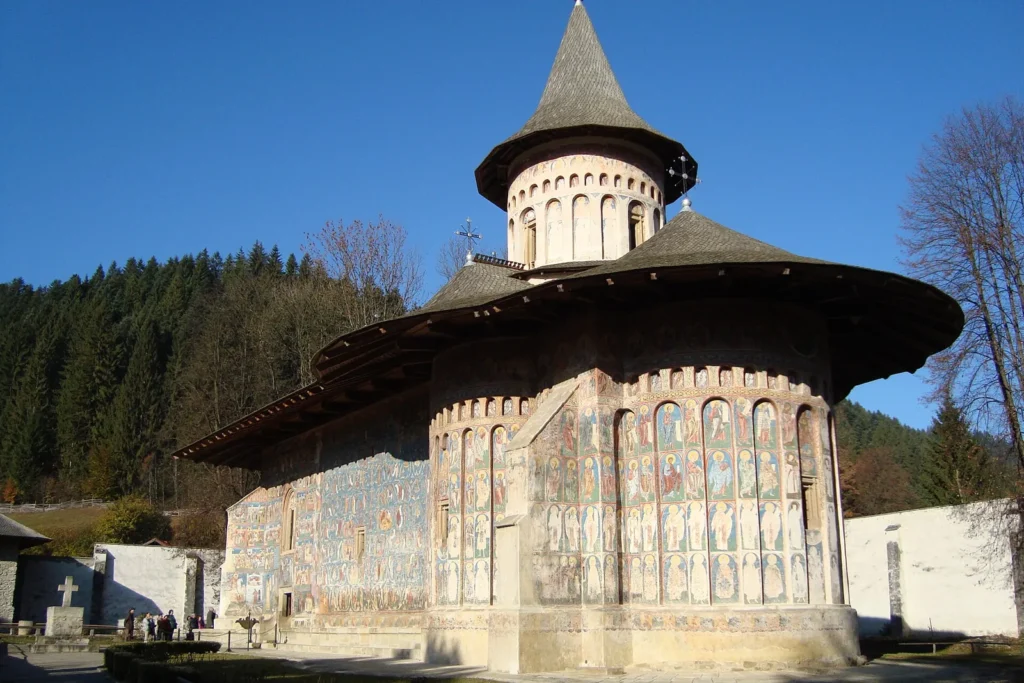
Voroneț is the best known of Bukovina’s painted churches and is sometimes called the “Sistine Chapel of the East”. It was built under Stephen the Great in 1488; according to the surviving inscription, construction took just three months and three weeks. The exterior paintings came later, in 1547, under Metropolitan Grigorie Roșca.
Voroneț’s great treasure is the west wall with its vast Last Judgement, which reads in tiers from top to bottom: Christ the Judge, the apostles, the processions of the righteous and the damned, the river of fire and the resurrection of the dead. Note the background: an intense blue that Romanians call “Voroneț blue” (albastru de Voroneț). Researchers still debate the exact recipe of the pigment.
Voroneț is a few kilometres from Gura Humorului and is the most visited monastery in the region. To see it in peace, come at opening time or towards evening. There are souvenir stalls and cafés by the gate.
Humor
Humor Monastery lies a few kilometres north of Gura Humorului. The church was built in 1530 at the expense of the chancellor (logofăt) Toader Bubuiog and his wife, and painted in 1535. Its distinctive features are an open porch on the west side and the reddish-brown tones that dominate the paintings. On the south wall the Akathist Hymn includes the Siege of Constantinople. A stone tower nearby was added later, under Prince Vasile Lupu.
Humor is usually quieter than Voroneț, making it a good place to study the paintings without a crowd.
Arbore
The church at Arbore is a small building in the village of the same name, built in 1503 by the hetman Luca Arbore. It is a parish church rather than a monastery and looks humbler than Voroneț, but its frescoes of 1541, by the painter Dragoș Coman, are highly regarded — especially the shades of green on the west wall. You can reach Arbore from Gura Humorului or on the way towards Rădăuți.
Evening in Gura Humorului
Gura Humorului is a small, quiet town on the Moldova river with several hotels and many guesthouses (pensiuni). It is a convenient place to eat local food and spend two nights in a row, making day trips from here. There are forest trails and viewpoints nearby.
A sample monastery-day timetable
To keep a monastery day from turning into a race, try a rhythm like this (by car, from Gura Humorului):
- 8:30–9:30 — Voroneț, before the groups.
- 10:00–10:45 — Humor.
- 11:00–12:00 — drive into the Moldovița valley, stopping at an egg-painting workshop.
- 12:00–13:00 — Moldovița.
- 13:00–14:00 — lunch at a guesthouse or roadside restaurant.
- 14:00–15:00 — the Ciumârna pass and its viewpoint.
- 15:00–16:30 — Sucevița and the monastery museum.
- 17:00 — Marginea and its black-pottery workshops, then overnight in Rădăuți or back to your base.
This is the packed version. If you are travelling with children or want more time at each church, split it over two days as in the main plan.
Day 5. Moldovița, Sucevița and the craft villages
This is the most scenic day of driving. From Gura Humorului the road runs into the Moldovița valley, then over the Ciumârna pass to Sucevița. The hairpins on the pass are beautiful but call for careful driving.
Moldovița
Moldovița Monastery was founded by Prince Petru Rareș in 1532 and painted in 1537. The church is enclosed by fortified walls with towers, and the courtyard holds a well-kept garden. Among the frescoes, the Siege of Constantinople on the south wall stands out: nominally it depicts a 7th-century siege, but for contemporaries it was a transparent allusion to the struggle against the Ottoman Empire. The Akathist scenes and the Tree of Jesse are also well preserved. The monastery has a small museum.
Crafts: painted eggs, pottery and carving
Between Moldovița and Sucevița it is worth stopping in a craft village:
- Vama and Vatra Moldoviței. The region keeps alive the tradition of decorating Easter eggs with wax and dyes. In Vatra Moldoviței a private painted-egg museum displays a collection and, if you are lucky, runs a demonstration.
- Ciocănești. A village further west, known for houses whose façades are painted with traditional patterns, and for its painted-egg museum. It requires a detour towards Câmpulung Moldovenesc.
- Marginea. A village on the way from Sucevița to Rădăuți, known for black pottery. In the workshops you can watch potters at work and buy directly from them.
Buying from craftspeople supports a living tradition — here it is not museum exotica but part of many families’ livelihoods.
Sucevița
Sucevița is the largest and, many would say, the most impressive of the painted monasteries. It was built in the late 16th century by the Movilă family — the brothers Ieremia, Simion and Metropolitan Gheorghe Movilă. Surrounded by massive walls with corner towers, it looks like a fortress. Unlike the other churches, Sucevița’s west wall was left unpainted; legend links this to the death of the painter, but there is no documentary evidence for it.
The highlight is the north wall with the Ladder of Divine Ascent: angels help the righteous climb towards heaven while devils pull sinners down. Sucevița’s paintings are notable for their wealth of scenes and rich greens and reds. The monastery museum holds embroidery, manuscripts and liturgical objects.
There are guesthouses next to the monastery, and some travellers stay here on purpose to see Sucevița early in the morning before the groups arrive.
Day 6. Putna and the road north
Putna
Putna Monastery was founded by Stephen the Great in 1466 and consecrated in 1469. For many Romanians and Moldovans it is the most important shrine of all: Stephen the Great, venerated as a saint by the Romanian Orthodox Church, is buried here. The church has been rebuilt several times after fires and earthquakes, so it does not look like Bukovina’s painted churches, but the significance of the place is immense. The museum holds one of the region’s finest collections of medieval embroidery, manuscripts and church plate.
Putna is surrounded by wooded hills. Nearby is the rock-cut cell of Daniel the Hermit (Chilia lui Daniil Sihastrul): according to tradition, Stephen the Great came to this hermit for advice. A short path leads to the cell.
Rădăuți
East of Putna lies Rădăuți, a small town with one of Moldavia’s oldest stone churches, Bogdana, where the principality’s first rulers are buried. The town is also the birthplace of ciorbă rădăuțeană, a hearty chicken soup with garlic and sour cream now cooked all over Romania.
Getting back: two options
Via Lipcani. For a loop, the road from Rădăuți heads east through Botoșani to the Rădăuți-Prut — Lipcani crossing in northern Moldova, then on through Edineț and Bălți to Chișinău. In Moldova you can detour to the fortress of Soroca on the Dniester if time allows. Note that this northern crossing is small; check its opening hours in advance.
Via Iași. If you came by public transport or returned your car in Iași, it is simplest to go back the same way: train or bus from Suceava to Iași, then a bus to Chișinău. You can split the return over two days with another night in Iași.
Day 7. A spare day or an extension
We keep the seventh day in reserve — for a long border wait, bad weather or simply the wish to stay longer. If everything went to plan, there are several options:
- The Rarău massif and the Pietrele Doamnei rocks. A mountain area above Câmpulung Moldovenesc with famous limestone crags and views over Bukovina. The road up is steep in places; check its condition.
- Câmpulung Moldovenesc. A small town with a museum of wooden folk art.
- The Neamț area. South of Suceava, outside Bukovina proper, are Neamț Fortress and the Neamț, Agapia and Văratec monasteries — enough for a separate route.
- Another day in Iași on the way back, for the museums you missed.
Festivals and events along the route
You can time your trip around local celebrations — they give the route extra character, but they also bring crowds.
- Easter. Orthodox Easter is the biggest holiday of the year in both countries. In Bukovina it means painted eggs, night services and festive tables. The date changes every year; book accommodation early.
- Monastery feast days (hramuri). Every monastery has its patronal feast, when pilgrims gather from the surrounding villages. Dates are listed on monastery websites or by the Archdiocese of Suceava.
- The feast of St Parascheva in Iași. Around 14 October — Romania’s largest pilgrimage.
- Summer festivals in Suceava. Medieval festivals are sometimes held at the fortress; check that year’s programme.
- Christmas and New Year. In winter, Bukovina’s villages keep carolling traditions and masked processions alive. It is beautiful, but roads may be snowy.
For a month-by-month overview, see our calendar of events in Moldova and Romania.
Getting around Bukovina without a car
Without a car the route is harder but doable.
- Iași — Suceava. Regular trains and buses; the trip takes a few hours.
- Suceava — Gura Humorului. Trains towards Câmpulung Moldovenesc and buses. Gura Humorului makes a good base.
- To the monasteries. From Gura Humorului you can walk or take a taxi to Voroneț, and a taxi or bike to Humor. Moldovița and Sucevița are best reached by taxi with a driver for the day or on a tour from Suceava.
- Tours from Suceava. Local agencies and guides offer day tours of the monasteries. Choose ones that clearly state the route, the time at each stop and what is included.
Romanian timetables change with the seasons, so check carriers’ websites and apps shortly before travelling.
Tips for photographers
- The best light for the façades is early morning and evening. Midday sun creates harsh shadows and glare on the paintings.
- North walls are usually in shade — an overcast day suits them.
- A wide-angle lens helps with façades in cramped courtyards; a telephoto picks out details high on the walls.
- Do not fly drones over monasteries or villages without permission; Romania’s drone rules are strict, so check them in advance.
- Autumn (late September to October) brings vivid forests around Sucevița and Putna.
Comparing the monasteries: where to go if time is short
If you only have one day in Bukovina, you will have to choose. This table shows how the main monasteries differ.
| Monastery | Date | Known for | Time needed | UNESCO |
|---|---|---|---|---|
| Voroneț | 1488, paintings 1547 | Last Judgement, “Voroneț blue” | 1 hour | yes |
| Humor | 1530, paintings 1535 | open porch, red tones, quiet | 45 minutes | yes |
| Moldovița | 1532, paintings 1537 | fortified walls, Siege of Constantinople | 1 hour | yes |
| Sucevița | late 16th century | Ladder of Divine Ascent, fortress, museum | 1.5 hours | yes |
| Arbore | 1503, paintings 1541 | shades of green, small village church | 30–40 minutes | yes |
| Putna | 1466 | tomb of Stephen the Great, embroidery museum | 1–1.5 hours | no |
| Dragomirna | early 17th century | tall, narrow church, carved stone band | 1 hour | no |
The one-day minimum: Voroneț in the morning, then Humor, and in the afternoon Moldovița and Sucevița over the pass. It is a busy but manageable day by car. Without a car, stick to Voroneț and Humor, the closest to Gura Humorului.
Shorter and longer versions
Four days: the essentials
- Day 1. Chișinău — Iași, evening walk in the centre.
- Day 2. Morning in Iași (Palace of Culture, Three Hierarchs, cathedral), then on to Gura Humorului in the afternoon.
- Day 3. Voroneț, Humor, Moldovița, Sucevița.
- Day 4. Back to Chișinău via Iași or via Lipcani.
This version is tiring and leaves little slack, but it covers the highlights.
Five days: the standard
- Day 1. Chișinău — Iași.
- Day 2. Iași.
- Day 3. Iași — Suceava (fortress, village museum) — Gura Humorului.
- Day 4. Voroneț, Humor, Moldovița, Sucevița, Marginea.
- Day 5. Putna, then back via Lipcani to Chișinău (a long day) or via Iași.
Seven days: unhurried
As described above: two days in Iași, then a day each for Suceava with Dragomirna, Voroneț with Humor and Arbore, Moldovița with Sucevița and the crafts, Putna with Rădăuți and the return, plus a spare day for Rarău or the Neamț area.
If you fly in via Iași
If you land at Iași airport or Suceava (which has its own small airport), you can start in Romania and make Moldova the second half: Iași — Bukovina — the Lipcani border — Soroca — Orheiul Vechi — Chișinău. For Moldova’s main sights, see our Moldova travel guide, and for Orheiul Vechi, our dedicated article.
Choosing a base in Bukovina
For the monasteries it is easiest to pick one base for two or three nights and make day trips. Here is how the main options compare.
| Base | Pros | Cons | Best for |
|---|---|---|---|
| Suceava | many hotels and restaurants, railway station, airport, fortress nearby | longer drive to Moldovița and Sucevița | travellers without a car or on tours |
| Gura Humorului | close to Voroneț and Humor, guesthouses, peaceful | fewer restaurants, quiet evenings | drivers and slow travellers |
| Sucevița and around | see the monastery in the morning without groups | few services, weaker signal | photographers and rural-stay fans |
| Câmpulung Moldovenesc | close to Rarău and mountain trails | far from Sucevița and Putna | nature lovers and hikers |
| Rădăuți | handy for Putna, Marginea and a return via Lipcani | not very touristy itself | those looping back through northern Moldova |
Many travellers combine them: one night in Suceava and two in Gura Humorului or a guesthouse near Sucevița.
Guesthouses (pensiuni)
Bukovina is one of Romania’s most developed regions for rural tourism. Guesthouses range from very simple rooms in a village home to comfortable places with restaurants, saunas and spas. Look at reviews for cleanliness, heating (spring and autumn nights are cold), parking, and whether breakfast and dinner are included. Hosts are often happy to suggest routes, arrange a driver or set up a visit to a craftsperson.
Budget
Romania is generally more expensive than Moldova, especially for accommodation and restaurants in Iași, but cheaper than most of Western Europe. Below is an order of magnitude, not a price list. All figures are approximate — check them for your travel dates.
| Expense | Rough guide (approx.) |
|---|---|
| Bus Chișinău — Iași | a few hundred Moldovan lei one way |
| Train or bus Iași — Suceava | a few dozen Romanian lei |
| Mid-range hotel room in Iași | roughly €50–90 per night |
| Guesthouse in Bukovina | roughly €35–70 per night, often with breakfast |
| Lunch at an inexpensive restaurant | roughly 40–80 RON per person |
| Monastery entrance | a small fee, plus a separate photo fee |
| Taxi or driver for a monastery day | depends on distance; agree the price in advance |
| Romanian e-vignette | a few euros for short periods; check current rates |
| Fuel for the whole loop | depends on the car; roughly 650–800 km of driving |
A note on money: in Romanian towns cards are accepted almost everywhere, but in villages, at markets, in small guesthouses and for monastery fees you will need cash. There are ATMs in Iași, Suceava, Gura Humorului and Rădăuți; small villages may have none. Change money at banks or official exchange offices, never on the street.
The food of Bukovina and Iași
Food is a reason in itself to take this route. The north of historical Moldavia is known for hearty mountain cooking.
- Ciorbă rădăuțeană. A sour chicken soup with garlic, sour cream and egg yolk, from Rădăuți.
- Bulz. Balls of polenta with cheese inside, baked or fried.
- Tochitură. A stew of pork and sausages served with polenta, cheese and a fried egg — for the very hungry.
- Mushroom dishes. In season Bukovina is full of wild mushrooms, cooked in soups and with polenta.
- Trout and lamb pastrami often appear on menus in the hills.
- Papanași. Cheese doughnuts with sour cream and jam — the cult dessert.
- Cozonac. A sweet festive bread with walnuts or poppy seeds.
- Afinată. A home-made bilberry liqueur often offered at guesthouses.
At Bukovina guesthouses dinner is often cooked by the hosts from local produce — ask when booking whether it is included.
Practical tips
Driving in Romania
- Outside built-up areas, dipped headlights are mandatory during the day.
- Romania is very strict about drink-driving — in practice, zero tolerance. The same goes for Moldova.
- Speed limits are enforced by cameras and patrols, and fines are substantial.
- In villages you may meet horse-drawn carts, unlit bicycles and animals on the road. Drive slowly at night.
- Parking in central Iași and Suceava is paid, via machines or apps.
Staying connected
Customers of EU operators — and, since 1 January 2026, of Moldovan operators — enjoy roaming at domestic rates in both Romania and Moldova. Others can buy a local SIM (in Romania: Orange, Vodafone, Digi and others). Coverage is patchy in some Bukovina valleys, so download offline maps.
Safety
The route is generally calm. The main risks are road and everyday ones: watch your belongings in crowds (especially during the Iași pilgrimage), do not leave valuables in view in the car and take care on mountain roads. Stray dogs are found in villages and around monasteries; do not provoke them. The emergency number in both countries is 112.
Language
Romanian is spoken in Romania. A few useful phrases: “Bună ziua” (good day), “Mulțumesc” (thank you), “Cât costă?” (how much is it?), “Nota, vă rog” (the bill, please).
What to bring home
- Black pottery from Marginea — hand-made pots, jugs and bowls.
- Painted eggs — real blown eggs decorated with wax, or wooden ones. Pack fragile souvenirs carefully.
- Icons and religious items from monastery shops. Many monasteries rely on these sales and on donations.
- Embroidery and textiles — traditional blouses (ie), towels and rugs. Genuine hand-work costs noticeably more than factory-made; ask the seller.
- Honey, wild-berry jams and bilberry liqueur — from guesthouse hosts and markets.
- Books and albums on the monasteries — in monastery shops and Iași bookshops.
Remember customs rules on the way back: Moldova has its own limits on alcohol and other goods, so check them in advance.
If you want more: nearby extensions
- Siret. One of Moldavia’s first capitals, with the old Holy Trinity Church, right by the Ukrainian border.
- Solca. A small town with a fortified early-17th-century church and a brewery.
- The Neamț area. Neamț Fortress and the Neamț, Agapia, Văratec and Secu monasteries — material for a separate 2–3 day route.
- Maramureș. Wooden churches, also on the UNESCO list, in north-western Romania, a few hours from Bukovina on mountain roads.
- Transylvania. Over the Eastern Carpathian passes you can continue to Bistrița, Cluj or Brașov.
What to pack
- Comfortable shoes — monastery courtyards are cobbled and paths lead to hermitages and viewpoints.
- Monastery-appropriate clothing: covered shoulders and knees, a headscarf or shawl.
- A warm layer — Bukovina evenings are cool even in summer.
- A rain jacket: the weather changes fast in the Carpathian foothills.
- Romanian lei in cash and a few Moldovan lei for the way back.
- Offline maps and a charged power bank.
- Car documents and proof of your vignettes, printed or digital.
Common mistakes
Too many monasteries in one day
Five or six monasteries a day is possible in theory, but by evening they blur into one. Better three or four churches seen properly than ticks on a list.
No buffer for the border
If you have a flight from Iași or Chișinău, allow several hours of margin for the border. Queues can stretch on holidays and weekends.
Cheese and sausage in your luggage
Entering the EU from Moldova, strict limits apply to animal products. Home-made cheese, meat and dairy will most likely have to stay at the border.
Relying on Russian
In Moldova Russian almost always works; in Romania it does not. Have a translation app ready and learn a few phrases.
Renting a car without cross-border permission
Not every Chișinău rental company allows trips to Romania. If you do not check in advance, you may run into trouble at the border.
Only one night in Iași
Iași is often treated as a transit stop, yet it is one of the most interesting cities in the region. If you can, give it at least a day and a half.
Who this route suits
- History and art lovers. Perhaps the best route in the region for medieval Moldavian art.
- Pilgrims. The shrines of Iași, Putna and Suceava and dozens of working monasteries make it an important pilgrimage route.
- Families. Children enjoy the Suceava fortress, the open-air museum and egg-painting workshops. Factor in the long drives.
- Photographers. Monastery façades, wooden houses, mountain roads and autumn forests.
- Food lovers. Hearty Bukovina cooking and guesthouses serving home-made meals.
Travelling responsibly
- Stay in family-run guesthouses and buy crafts directly from makers.
- Respect monastery rules: these are places of prayer first, not museums.
- Do not touch the frescoes, and do not use flash where photography is allowed.
- Leave no litter on trails and at viewpoints.
- Ask before photographing people, especially monks, nuns and elderly villagers.
Pre-trip checklist
- Check Romania’s entry requirements for your nationality.
- Make sure your passport is valid for the whole trip.
- Buy travel medical insurance that covers both countries.
- If driving: Green Card, Moldovan and Romanian vignettes, rental company permission.
- Book accommodation in Iași and Bukovina, especially in summer and mid-October.
- Check your chosen border crossing and transport timetables.
- Get Romanian lei in cash and download offline maps.
Final thoughts
The Chișinău — Iași — Bukovina route is a journey through one historical land now divided by a border. In a week you will see the former capital of Moldavia with its palaces and churches, Stephen the Great’s fortress at Suceava and painted monasteries unlike anything else in Europe. The key is not to rush: take time to look at the frescoes, talk to your guesthouse hosts and try the local food. Bukovina rewards slow travellers: the most memorable moments often happen not in front of the famous façades but in a conversation with a potter in a village workshop, on a quiet path to a hermitage or over dinner while your host explains how Easter is celebrated here.
Before you go, double-check entry rules, border crossings and timetables. For more on the border, read our guide to crossing between Moldova and Romania, and for holiday dates, including the St Parascheva pilgrimage, see our events calendar.
For more trip ideas, browse our Routes, Places and Advice sections.
Frequently asked questions
How many days do you need for a Chișinău–Iași–Bukovina trip?
Four to five days is the minimum: one day for the drive and Iași, one day for the city, two days for the Bukovina monasteries and one to get back. Six or seven days is more comfortable and lets you add Putna, Dragomirna, the craft villages and the Rarău pass.
Which border crossing is best from Chișinău to Iași?
Sculeni is the closest to Iași. Leușeni–Albița is the main road corridor; it is longer for Iași but has a good road to Chișinău. For going straight to Bukovina, the northern Lipcani–Rădăuți-Prut crossing is convenient. Traffic varies, so check the border police websites.
Can you do the route without a car?
Yes, but it is slower. Buses and minibuses link Chișinău and Iași, and trains and buses run between Iași and Suceava. Public transport to the monasteries themselves is infrequent, so in Bukovina a taxi, a guided tour or a local rental car is easier.
Do I need a vignette to drive in Romania?
Yes. Driving on Romania's national roads requires an electronic vignette (rovinieta), sold online and at petrol stations near the border. Foreign-registered cars also need a vignette in Moldova. Check current rates on the official websites.
How much does it cost to visit the Bukovina monasteries?
There is usually a small entrance fee and a separate fee for taking photos or video. Amounts change, so treat any figure as approximate and carry some Romanian lei in cash.
When is the best time to visit Bukovina?
May to October: it is warm, guesthouses are open and mountain roads are clear. Autumn colours are especially beautiful, but around 14 October Iași hosts a huge pilgrimage to the relics of St Parascheva and the city is packed.
Image credits:
- Voroneț Monastery in Bukovina with its painted exterior walls — Photo: Aupaelfary / Wikimedia Commons, CC BY-SA 3.0 ro
- The Palace of Culture in Iași, a neo-Gothic building with a clock tower — Photo: Losy / Wikimedia Commons, CC BY-SA 3.0 ro